Smart homes aren’t just for people who want to talk to their fridge or collect gadgets for sport. When it’s done right, tech quietly supports your routines, protects your time, and makes home feel more like…you. Think less “sci‑fi spaceship,” more “this place just runs smoothly while I live my life.”
Below are five innovative smart living ideas designed for modern homeowners who care about mood, aesthetics, and ease—not just specs and speeds.
1. The “Landing Zone” Home: Your Doorway Becomes Your Daily Reset
Instead of a random pile of keys, shoes, and mail by the door, imagine your entry acting like a scene change in a movie—everything shifts the second you walk in.
A smart “landing zone” can include motion or contact sensors at the door that trigger a specific routine: soft hallway lights, your favorite chill playlist at low volume, and an instant thermostat nudge to your comfort temperature. A slim smart display or tablet near the door can show what you actually need to see at that moment: package arrivals, calendar for tomorrow, weather, and whether you remembered to close the garage.
Add a small wireless charging tray and a smart lock that auto-locks behind you, so you drop your phone, kick off your day, and stop wondering if you locked the door. Over time, you can train this zone to understand weekday vs. weekend patterns—weekday evenings prioritize lights and music, while weekend afternoons surface reminders like “plants need watering” or “guests arriving in 30 minutes.” The entry way stops being a clutter catch-all and starts working like a daily reset button.
2. Adaptive Comfort: A Home That Learns How You Actually Live
Most people set their thermostat once, complain about the bill, and then forget it exists. Smart comfort turns that into a feedback loop that learns you. The goal: your home feels consistently good with less energy waste and zero micromanaging.
Modern smart thermostats and connected sensors can track when you’re usually home, what temperatures you prefer at certain times, and which rooms you use most. Instead of blasting the whole house, zoning and smart vents can direct heating or cooling where you actually are—your office during work hours, the bedroom before you sleep, the living room when you host.
You can layer in adaptive lighting as part of comfort: lights warming up and dimming as the evening goes on, cooler and brighter tones in the morning to help you wake up. For allergy-prone households, connected air purifiers and smart HVAC filters can respond to outdoor air-quality alerts or indoor pollutant spikes and automatically run a deeper clean cycle.
The result isn’t “wow, such advanced tech,” it’s “weird, I don’t think about the temperature or air anymore—it just feels right.”
3. Frictionless Mornings: A Subtle Automation-First A.M. Routine
Morning routines don’t need to be a full wellness ritual to benefit from smart help. A few quiet automations can turn “scramble” into “steady,” even if you’re not a 5 a.m. person.
Start by syncing your alarm with your smart home platform, so when it goes off, your blinds crack open, bedside lights glow up slowly instead of instantly blasting you, and your preferred news, ambient sounds, or playlist fades in. Pair a smart plug or connected coffee maker with a wake-up scene so you actually smell the coffee when you sit up.
A small smart display in the kitchen can show a single, clean dashboard: commute time, weather, first calendar event, and any alerts (like the front door being left unlocked or the garage still open). For homes with kids, you can add “school mode” lighting—brighter, crisper kitchen or dining lights during breakfast to help everyone wake up and move.
Rather than asking a voice assistant a dozen questions, pre-build one quiet morning routine that just happens, so you move from bed to coffee to door with fewer decisions and less chaos.
4. Entertaining Mode: Hosting That Feels Polished, Not Performative
Good hosting is about how people feel in your space, not how many gadgets you can show off. Smart home ideas can support that without turning your living room into a demo zone.
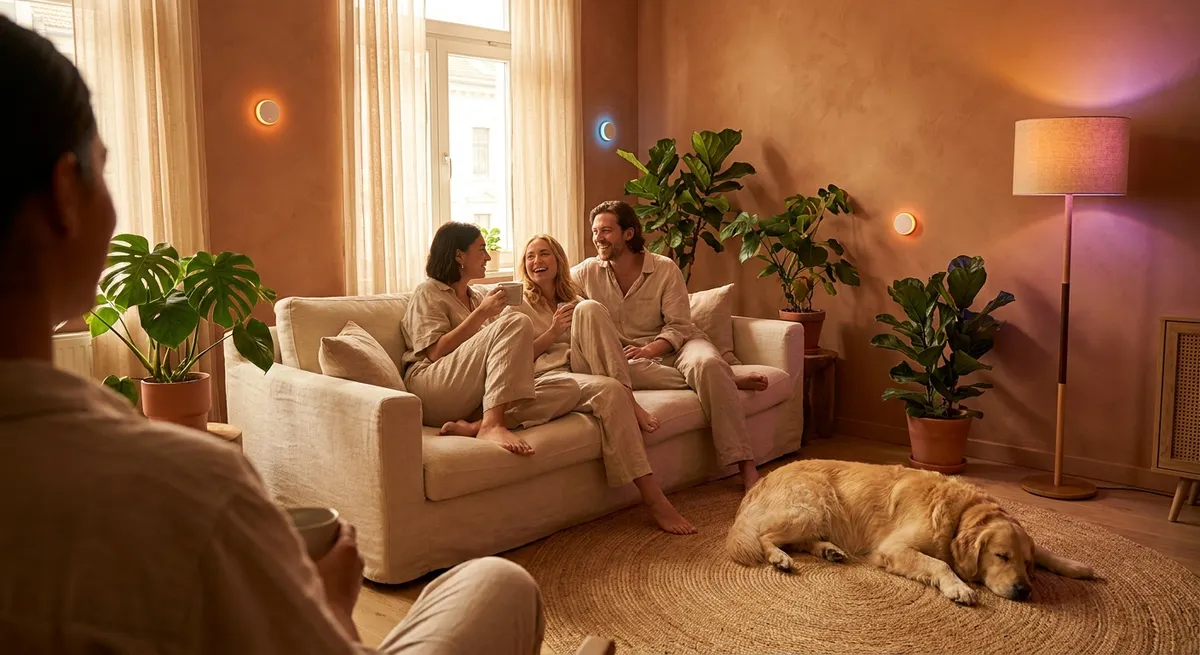
Create a “guest arrival” scene that softens overhead lights, turns on warm floor or table lamps, plays a curated playlist at a conversation-friendly volume, and adjusts the thermostat to a slightly cooler “lots of bodies in the room” setting. A smart doorbell with a discreet chime and video feed to your phone lets you greet guests without rushing from the kitchen.
If you host movie nights or game nights, a dedicated “viewing mode” can close smart shades, lower the lights behind the seating area, and bump the sound system to a pre-set level. For dinners, you can use smart bulbs to shift from bright meal-prep lighting to candle-level glow once food hits the table.
The key is to pre-build these modes so you’re not shouting “Hey, turn on…wait…no, not that” while people are watching you. Your home feels thoughtfully staged, but your attention stays on your guests, not your devices.
5. Calm Security: Protection That Blends In and Lowers Anxiety
Security doesn’t have to look like you’re guarding a bank vault. Modern smart security can feel almost invisible while giving you real peace of mind, especially when you’re traveling or living in a busy city.
Smart locks let you create temporary access codes for dog walkers, cleaners, or guests instead of hiding keys. Video doorbells and discreet outdoor cameras can send you smart alerts based on actual activity—like a package being dropped off or repeated motion in a certain zone—rather than pinging you every time a car passes by. Indoors, contact sensors on doors and windows can double as “did I leave that open?” checks in your app.
“Away” scenes can be set to mimic normal life: randomizing lights in a few key rooms, running shades up and down at typical times, and pausing non-essential plugs to save energy. Smoke and carbon monoxide detectors that are part of your smart ecosystem can send alerts to your phone, not just ring in an empty house.
Well-designed security should make you less aware of risk, because you know your home will tell you when something’s actually off—and stay quiet when everything’s fine.
Conclusion
Smart homes aren’t about owning the most tech—they’re about removing tiny frictions from everyday life so your home feels calmer, more intentional, and more “you.” When your space adapts to your habits, supports your routines, and anticipates what you need, the tech fades into the background and lifestyle takes the lead.
If you’re starting from scratch, pick one area that feels the most chaotic—mornings, coming home, or hosting—and build a simple scene or routine around that. Let your home prove it can be quietly clever before you add anything else.
Sources
- U.S. Department of Energy – Thermostats and Control Systems – Overview of how programmable and smart thermostats can improve comfort and reduce energy use
- EPA – Guide to Air Cleaners in the Home – Details on air quality, filtration, and how home devices can support healthier indoor air
- Consumer Reports – Smart Home Guide – Independent testing and explanations of different smart home categories and features
- FTC – Using Smart Home Devices Safely – Government guidance on privacy, security, and safe use of connected home devices
- Harvard Joint Center for Housing Studies – The Connected Home and Aging in Place – Research on how smart home tech can support comfort, independence, and safety in residential spaces
Key Takeaway
The most important thing to remember from this article is that this information can change how you think about Smart Homes.