Your home is no longer just where you plug in your devices—it’s where the tech quietly reads the room, matches your mood, and makes everyday life feel a little more cinematic. Modern home tech isn’t about stuffing every corner with gadgets; it’s about layering in just enough intelligence so your space feels tuned to you: your energy, your habits, your people.
Below are five innovative home-living ideas that feel modern, lived-in, and made for people who want their space to work as hard as they do, without looking like a showroom.
1. Atmosphere Engines: Scenes That Shift With You
Instead of thinking in “devices,” think in scenes: morning reset, deep focus, dinner with friends, Sunday recharge. Atmosphere engines are about linking lighting, sound, temperature, and even scent so your space snaps into a different mode with one tap or a simple voice cue.
Smart bulbs and connected switches can softly wake you with warmer tones and gradually brighter levels, then cool off to crisp white for productivity. Paired with a smart speaker or soundbar, your focus playlist, ambient rain, or lo-fi beats can trigger alongside your lighting presets. Smart thermostats close the loop, nudging the temperature a degree or two to match the vibe—slightly cooler for high-focus, slightly warmer for lounging. Add a discreet smart diffuser or fan with essential oils, and your home can “remember” that your evening wind-down scene comes with dimmed amber light, gentle audio, and a hint of lavender. The result: your home starts to feel choreographed, not random.
2. Invisible Interfaces: Tech That Disappears Into the Design
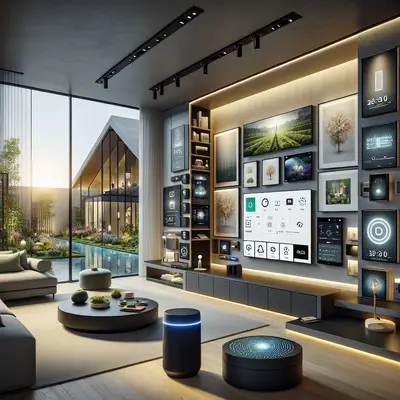
The future of home tech isn’t more screens; it’s fewer obvious ones. The most modern spaces are hiding the tech in plain sight—inside mirrors, frames, cabinetry, and textiles—so your home still feels like a home, not a control room.
Think: a bathroom mirror with built‑in lighting presets and weather info that appears only when you need it. Or a living room where your TV looks like wall art when it’s idle, blending into a gallery wall instead of dominating it. Under‑cabinet outlets and wireless charging built into side tables or kitchen islands keep surfaces visually clean but always ready for a quick power-up. Slim, wall‑mounted speakers that match your trim color or fabric‑front smart hubs that look like decor pull the tech back into the background. Minimal visual noise, maximum function. The goal is seamless: your guests notice the vibe, not the devices that created it.
3. Micro-Zones: Carving Out Smart Pockets of Daily Life
Forget rigid “rooms.” Modern living is all about micro‑zones: tiny pockets of highly functional space that layer into the open-plan layouts so many people live in now.
A kitchen corner becomes a “coffee lab” with a smart plug for your espresso machine, app-controlled kettle, and a motion-sensitive light strip under the shelf that glows on when you walk in half-awake. A window nook turns into a calm reading zone with a small smart lamp, noise-cancelling headphones dock, and an e-ink tablet charger hidden in the side table. Near the entry, a drop spot with a smart lock, package camera, and key tray that doubles as a wireless charger turns the chaos of coming and going into something more composed. Zoning your home by behavior—not walls—lets you build mini experiences that feel intentional, even in smaller or shared spaces.
4. Health-Aware Spaces: Subtle Tech for Better Daily Habits
Wellness tech isn’t just wearables anymore; it’s making its way into how your entire home behaves. A health-aware home quietly supports better sleep, cleaner air, and more movement—without nagging you.
Smart air purifiers and connected HVAC filters can monitor air quality and automatically kick in during high‑pollution hours or peak allergy seasons. Circadian lighting systems shift color temperature through the day to align more closely with natural light patterns, helping your brain understand when it’s time to focus versus time to wind down. In the bedroom, blackout shades paired with sunrise alarms and temperature‑aware thermostats can support more consistent sleep. Even small things—like a standing desk that adjusts heights via preset, or occupancy sensors that remind you to move after long periods at your desk—nudge you toward better daily rhythms. The tech stays low‑key, but your habits start to feel more sustainable.
5. Neighbor-First Smart Living: Connected but Considerate
Smart homes don’t just impact you—they shape how your place fits into your building, street, and neighborhood. The most future-forward setups consider privacy, security, and community impact from the start.
Video doorbells and outdoor cameras can make you feel safer, but aiming them thoughtfully, managing notifications, and using privacy zones can keep neighbor relationships healthy. Smart outdoor lighting that’s motion‑sensitive and downward‑facing can boost security without blasting glare into someone else’s windows. EV chargers, smart plugs, and energy-monitoring systems help you understand when your home is drawing the most power, so you can shift laundry, dishwashing, or charging to off-peak hours—lighter on the grid, lighter on your bill. Shared spaces like apartment lobbies or rental ADUs are getting smarter too, with app-based access and temporary digital keys for guests or cleaners. Done right, your tech-forward home becomes easier to live in and easier to live next to.
Conclusion
Home tech is evolving from “look what this gadget can do” to “look how this space feels to live in.” It’s less about chasing every new device and more about curating a stack of tools that match your energy, your routine, and your design point of view.
Start with one idea—a mood-based lighting scene, a hidden tech upgrade, or a smarter wellness corner—and let the rest build from there. The most modern homes aren’t the most high-tech; they’re the ones where every upgrade quietly earns its place in your everyday life.
Sources
- U.S. Department of Energy – Smart Home and Smart Grid – Overview of how smart home devices interact with the broader energy grid and impact usage
- Harvard T.H. Chan School of Public Health – Air Quality and Health – Research and guidance on why indoor air quality matters for health and how tech can help
- Mayo Clinic – Sleep and Light Exposure – Explains circadian rhythms and how light impacts sleep and wellbeing
- National Institute of Standards and Technology (NIST) – Smart Home Cybersecurity – Best practices and considerations for keeping connected homes secure
- Consumer Reports – Guide to Smart Home Devices – Independent testing and reviews of a wide range of smart home products and systems
Key Takeaway
The most important thing to remember from this article is that this information can change how you think about Home Tech.