Life is happening at home more than ever—work calls, slow mornings, late-night streaming, and everything in between. Interior design isn’t just about what looks good on Instagram anymore; it’s about how your space actually works for your real life. Think less “perfect showroom,” more “this feels like me, and it just…flows.”
Below are five innovative home-living ideas modern homeowners are leaning into right now—design moves that make your space feel elevated, intentional, and seriously livable.
1. The “Third Space” Corner: Not Office, Not Sofa, Something In Between
We’re all familiar with the kitchen table “office” and the couch “coworking space”—but the new essential is a third space corner: a micro-zone that’s not for work and not for TV, but for you.
Think of it as your in-house café lounge:
- A low, comfy chair or small lounge chair (not a task chair, not a recliner).
- A petite side table that fits a book, a drink, and your phone.
- Soft, directional lighting—like a floor lamp with a warm bulb, or a plug-in sconce.
- A textured throw and one substantial cushion, instead of a pile of them.
Design it like a reset button. Keep this corner intentionally tech-light: no ring lights, no monitor, no cables. It’s where you scroll in the morning sun, sip tea at night, or read two pages of a book and call it self-care.
Pro tip: Place it near a window if you can. Natural light instantly upgrades the mood and makes the corner feel like a mini-retreat without needing extra square footage.
2. Future-Proof Furniture: Pieces That Work Harder Than They Look
The most interesting homes right now aren’t the ones packed with the most furniture—they’re the ones where every piece earns its place.
Future-proof furniture is:
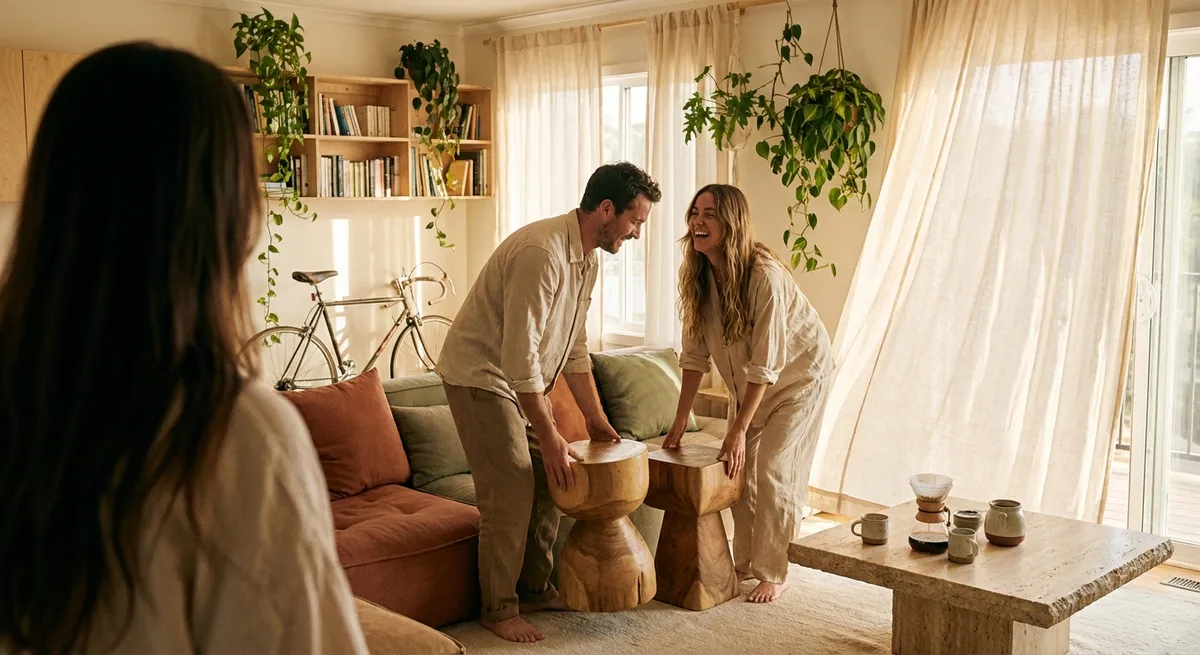
- Modular: Sofas with movable sections, ottomans that can shift from footrest to coffee table.
- Dual-purpose: Benches with storage, consoles that double as desks, nightstands with hidden outlets and cable management.
- Mobile: Slim rolling carts for bar setups, craft storage, or bathroom overflow; side tables that glide between sofa and bed.
Instead of buying for a single function (“this is a coffee table”), buy for a lifestyle pattern (“this is where we put drinks and play board games and work sometimes”).
To keep it feeling elevated rather than utilitarian:
- Stick to a tight palette of 2–3 materials (for example: light oak, matte black, and linen).
- Match hardware tones (brushed nickel, black, or brass) for a more cohesive look.
- Choose visually light silhouettes—raised legs, slim frames—to avoid a bulky, crowded vibe.
Your space stays flexible as your life shifts, but visually calm because everything’s speaking the same design language.
3. Color Zoning: Shape Your Day Without Moving a Single Wall
If you can’t add walls, you can still change how a room behaves using color zoning. It’s one of the most accessible interior tricks for modern living—especially in open layouts where the dining table, sofa, and laptop all share the same footprint.
Ways to color-zone without committing to a full-room makeover:
- Paint just the lower half of the wall behind your workspace or dining area. It subtly frames the zone without shrinking the space.
- Use a color-blocked rug to visually anchor a living area in a flexible room.
- Choose one accent color per zone (for example, earthy greens around your reading chair, warm terracotta around the dining table, and calm blues in the sleep area of a studio apartment).
Psychologically, cooler tones (blues, soft greens) can help calm and focus, while warmer tones (terracotta, mustard, clay) can feel cozy and social. Use that to your advantage: cool tones where you focus or rest; warm tones where you gather or play.
The result: the same square footage, but your brain experiences it as multiple “rooms” with different moods—no remodel required.
4. Display with Intention: Curated Surfaces That Tell Your Story
The new luxury is not a home with no stuff—it’s a home where what’s visible actually matters to you. Think curated surfaces rather than cluttered shelves.
Instead of packing every shelf and console, treat your home like a gallery of your life:
- Anchor pieces: One or two visually substantial items (a sculptural lamp, a large ceramic vase, a framed print) to ground the scene.
- Personal artifacts: Objects that connect to real memories—a ticket stub in a frame, a piece of pottery from a trip, a book you actually loved.
- Negative space: Leaving some breathing room is what makes the rest of the display look intentional, not accidental.
- Group items in odd numbers (3 or 5 tends to feel more natural).
- Mix heights—stack books horizontally, then add a small object on top.
- Balance textures: something glossy, something matte, something soft.
Try a simple styling framework for shelves and consoles:
Rotate your objects seasonally to keep things feeling fresh without buying new décor. You’re not just decorating; you’re editing your life into view.
5. Sensory Layering: Designing for How Your Home Feels, Not Just How It Looks
The most innovative interiors now are built around sensory experience—how a room sounds, feels under bare feet, and even smells throughout the day.
Consider these subtle but impactful moves:
- Sound: Add soft textiles—rugs, linen curtains, upholstered headboards—to absorb echo and make spaces calmer for calls, movies, or just thinking. In busy homes, this can be more transformative than a new sofa.
- Touch: Mix textures on purpose: cool stone or metal for surfaces you work on, plush upholstery where you lounge, nubby cushions or boucle throws for contrast. Variety keeps a room from feeling flat.
- Scent: Assign signature scents to different zones: something bright and citrusy in the kitchen, woodier or smokier in the living room, soft florals or herbal notes in the bedroom.
- Light: Layer it—overhead for function, task lighting for focus, and warm, low-level lamps or candles for evenings. Consider smart bulbs or dimmers to shift a room from “work” to “wind down” without rearranging anything.
Instead of redecorating every year, build a base you love visually, then play with sensory layers. It’s a quieter kind of upgrade, but it changes how you actually experience your home from morning to night.
Conclusion
Modern interior design is less about chasing trends and more about designing for the way you actually live. A thoughtful third-space corner, flexible furniture, color zoning, curated displays, and sensory layering aren’t just “aesthetic” ideas—they’re lifestyle upgrades.
When your home supports your routines, your downtime, and your in-between moments, everything feels a little more intentional, a little more grounded, and a lot more like you. That’s new-gen nesting: not a perfect house, but a home that moves with you.
Sources
- American Society of Interior Designers (ASID) – 2022 Trends Report - Insights on how wellness, flexibility, and multifunctional spaces are shaping interiors
- Harvard Joint Center for Housing Studies – Remodeling Futures - Research on how homeowners are rethinking and investing in living spaces
- Pantone Color Institute – Color and Design Trends - Background on how color influences mood and interior design choices
- Sleep Foundation – Impact of Light on Sleep - Explains why layered, adjustable lighting at home matters for rest and daily rhythms
- Centers for Disease Control and Prevention (CDC) – Noise and Health - Discusses noise exposure and why acoustic comfort at home is increasingly important
Key Takeaway
The most important thing to remember from this article is that this information can change how you think about Interior Design.