Smart homes aren’t just for tech people with endless gadgets anymore—they’re for anyone who wants a home that quietly takes care of the details. Today’s best setups aren’t about flexing specs; they’re about living better: softer mornings, calmer evenings, and spaces that respond to how you actually move through your day.
Below are five innovative smart living ideas that feel less “sci-fi demo” and more “I could actually live like this.”
1. The Adaptive Morning Routine: A Home That Wakes Up With You
Forget one loud alarm and harsh overhead lights. An adaptive morning setup stacks small automations so waking up feels like a natural transition instead of a jolt.
Imagine this: 20 minutes before your alarm, your blackout shades crack open just enough to let in soft light. A sunrise-style bedside lamp gently warms from amber to daylight tones. Your thermostat shifts from night mode to a slightly warmer setting, and your smart speaker starts a low-volume news briefing or a saved playlist—never blasting, always gradually.
The key is linking everything to your wake-up window instead of one fixed time. Many smart home platforms (like Apple Home, Google Home, or Alexa) now let you build “scenes” that trigger based on time, day of week, or even your phone’s first movement. That means your home can differentiate between a 6 a.m. workout morning and a slow Sunday.
This kind of routine doesn’t just feel luxe; it’s surprisingly practical. You’re less likely to hit snooze, more likely to ease into your day, and you can tweak every element—temperature, light, sound—until it feels right for your body and schedule.
2. Zoned Comfort: Micro-Climate Control for Real Life
Instead of blasting your entire home with the same temperature, zoned comfort lets you control the micro-climate of specific rooms based on how you actually live. The result: more comfort, less energy waste, and a space that feels subtly tuned to you.
Think smart thermostats linked to room sensors, smart vents, or even connected radiators. Your bedroom can cool down an hour before sleep, the home office can stay slightly warmer for focus, and the living room can shift to a cozy setting at night—all without manually walking around adjusting anything.
For older homes or apartments without built-in zoning, smart radiator valves, mini-split systems with Wi‑Fi control, and smart air purifiers or fans can achieve similar results. You can even set your home to “follow” you: when motion sensors detect you’ve left the living room for the bedroom, the system phases down one zone while optimizing another.
This isn’t just comfort theater—research shows that better temperature control can improve sleep quality and even productivity. Zoned comfort lets you customize that experience without turning your place into a science project.
3. The Entertainer’s Layered Audio-Visual Setup
Hosting is different when your home can subtly choreograph the mood. A layered audio-visual setup goes beyond a single speaker and TV; it’s an environment that shifts in sync with the moment.
Picture this: guests arrive and your entryway lights brighten automatically while subtle background music follows them into the kitchen and living room, staying at a conversational volume. If you move outdoors, your backyard speakers pick up the same playlist while indoor volume drops down. When it’s time for a movie or game night, one voice command or tap dims the lights, lowers the blinds, calibrates your TV or projector for cinema mode, and nudges the sound system into surround mode.
The trick is treating audio and lighting like zones, not individual devices. Smart speakers that can be grouped by room, smart bulbs or switches that can be saved into scenes (like “Dinner,” “Game Night,” “Afterparty”), and a universal remote app or hub keep everything from feeling chaotic.
What makes this feel modern isn’t just the tech—it’s the restraint. You don’t need colored lights everywhere or bass-heavy sound to impress people. Guests remember a home that feels intentional: flattering, warm lighting, seamless sound, and zero fumbling with remotes mid-conversation.
4. Invisible Wellness: Air, Light, and Habit Nudges in the Background
Wellness at home is shifting from obvious gadgets to subtle systems. Instead of a counter full of devices, modern homeowners are building invisible wellness layers into their space—things that support better living without shouting for attention.
Smart air quality monitors can quietly track pollutants, humidity, and even CO₂, then talk to connected air purifiers, fans, or HVAC systems to adjust automatically. If levels spike from cooking or cleaning products, a fan can kick on, a window sensor can remind you to crack it, or your system can boost ventilation temporarily.
Lighting can also play a wellness role. Tunable white bulbs that shift from cool to warm throughout the day can support your circadian rhythm: cooler, brighter light in the morning for alertness and warmer, dimmer tones at night for wind-down. You can set these shifts to mirror local sunrise and sunset times so your home naturally “knows” the season.
Layer in a few habit nudges—subtle notifications or lighting cues rather than loud alarms. For example, a gentle hallway light scene at 10:30 p.m. that signals “time to wrap up screens,” or a daily reminder on your smart display to refill your water carafe when you walk into the kitchen mid-afternoon. None of it screams “biohacking”; it just feels like your home has your back.
5. Flexible Spaces: Smart Tech That Adapts to How You Use a Room
Modern floor plans demand rooms that can do multiple jobs: office by day, yoga space at noon, cozy den at night. Smart tech can be the connective tissue that makes these transitions feel smooth instead of chaotic.
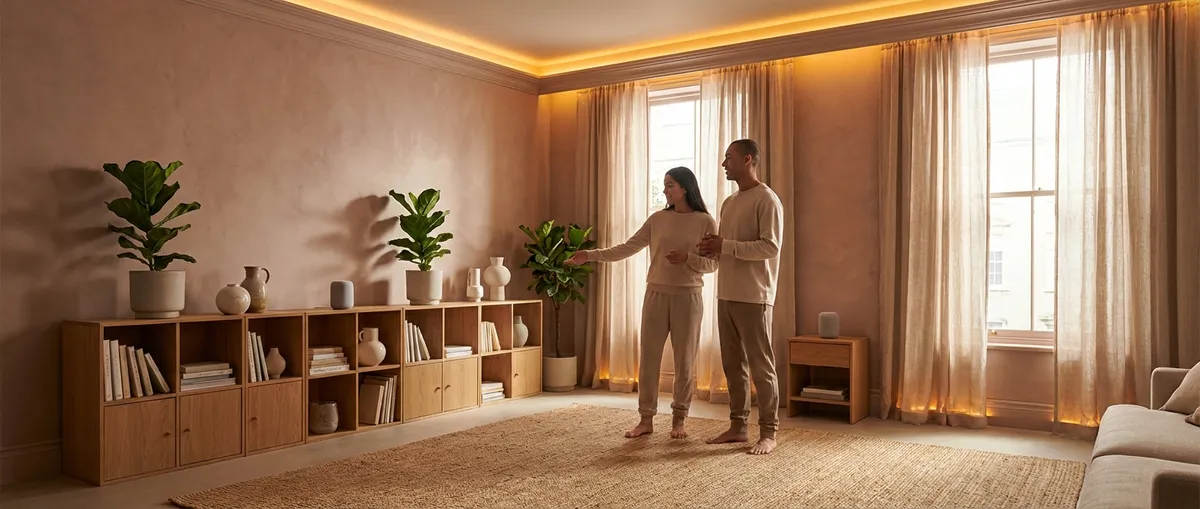
Start with lighting and window treatments. One room can have distinct identities through scenes: “Work Mode” (cooler light, bright task lamps, blinds down for screen glare), “Stretch Break” (softer overhead lighting, blinds partially open), and “Chill” (warm accent lamps, TV bias light on, overheads almost off). These aren’t just vibes—they’re cues to your brain that the room’s purpose has changed.
Add in small but powerful moves: a motorized standing desk that remembers sitting and standing heights; a wall-mounted tablet or smart display that switches from calendar and email during the day to ambient art in the evening; a sofa with a hidden power strip for clean laptop and device charging; a compact projector that drops down only when needed.
Smart storage can also be part of the picture: app-controlled locks on certain drawers or cabinets (useful if you’re blending work and family spaces), or sensor-based lighting inside closets and under-shelf strips that make transitions easier. The goal is a room that keeps up with the many versions of your day without you constantly rearranging or rewiring it.
Conclusion
The smartest homes right now aren’t the ones with the most devices—they’re the ones that feel the most livable. When tech fades into the background and your space quietly anticipates what you need next, you get a home that feels both effortlessly modern and deeply human.
You don’t have to implement everything at once. Start with one idea—a gentler morning, a better movie setup, or a more flexible office—and build from there. Over time, your home becomes less of a static backdrop and more of a responsive partner in how you actually live.
Sources
- U.S. Department of Energy – Thermostats and Control Systems - Overview of how smart thermostats and zoning can improve comfort and efficiency
- Mayo Clinic – Sleep Tips: 6 Steps to Better Sleep - Background on how light, temperature, and routine affect sleep quality
- Harvard Medical School – Blue Light Has a Dark Side - Explains the impact of lighting and screens on circadian rhythms
- EPA – Guide to Air Cleaners in the Home - Details on air quality, filtration, and why smart monitoring and purification matter
- Apple Home – Create Scenes - Practical reference on building multi-device scenes that mirror the kinds of automations described above
Key Takeaway
The most important thing to remember from this article is that this information can change how you think about Smart Homes.