Smart homes aren’t just for people who own a thousand gadgets and talk in acronyms. The most livable, future‑ready spaces right now are the ones where the tech fades into the background—and your actual life gets easier, calmer, and a little more beautiful. This isn’t about turning your home into a spaceship; it’s about tiny, intentional upgrades that give you back time, energy, and headspace.
Below are five innovative home living ideas that feel considered, not complicated—and that modern homeowners are actually using, not just posting about.
1. The Invisible Entry: Frictionless Arrivals and Exits
The most underrated place to go “smart” is your front door—not just for security, but for how your home welcomes you in and lets you leave without chaos.
Think: a smart lock that knows your phone and unlocks as you walk up, while motion‑sensing lights gently bring up the entryway (inside and out) at dusk. Add a slim video doorbell that sends a discreet alert to your phone or smartwatch, so you can see who’s at the door without dropping everything. Combined, it turns your entry from a scramble for keys and switches into a calm, almost hotel-level arrival ritual.
Layer in a small console drawer with a wireless charging tray for keys, phones, and earbuds, plus a shoe drawer or bench with hidden storage. The idea is that tech handles the access and awareness (who’s coming, who’s going, whether the door’s locked), while the physical space handles the clutter. The result: fewer “Did I lock the door?” texts to yourself and more “Walk in, drop everything, and breathe” moments.
2. Flow-Based Lighting: Let Your Home Match Your Energy
Smart lighting has moved way beyond “change the color for movie night.” The new wave is about flow: lights that track your day and help your brain switch gears without you thinking about it.
In practice, that means setting your lights to a soft, warm glow in the morning instead of a harsh blast, gradually brightening in work zones (kitchen, office) when you need focus, then easing into deeper, warmer tones in the evening to help your body wind down. Many smart bulbs and switches now mimic natural daylight patterns—cooler and brighter mid-day, warmer and lower at night—which can support better sleep and focus.
You can also create “modes” that are more about lifestyle than tasks. A “Soft Reset” scene might dim living room lights to 40%, warm the color, and bring up a single floor lamp, perfect for that 30-minute scroll, book, or catch-up chat. A “Second Shift” scene could brighten only your home office and kitchen so you can work late without the whole home feeling “on.” When light supports how you actually live—WFH, side projects, late dinners—you spend less time micromanaging switches and more time in the moment.
3. Zoned Comfort: Climate That Knows Which Rooms Matter
Instead of setting one temperature for the entire house and hoping for the best, smarter homes are moving toward zones—comfort that follows where you actually spend time.
This can be as simple as a smart thermostat paired with a few wireless temp sensors in key rooms, or as advanced as motorized vents and multi‑zone HVAC. The thermostat learns that the bedroom runs cooler, the kitchen gets warm when you cook, and the living room is where evenings happen. Over time, it can adjust automatically so you’re not freezing in one room and boiling in another.
If you have a guest room or formal dining room that’s empty 90% of the time, add them to an “Idle” schedule so the system maintains a healthy baseline (no dampness or stuffiness) without fully conditioning unused space. Add ceiling fans or smart fans that sync with your thermostat for an extra layer of efficiency and comfort. You’re not just lowering your energy bills—you’re creating a home that feels consistently comfortable in the spaces that matter most day-to-day.
4. The Calm Kitchen: Smart Support Without a Screen Overload
The smartest kitchens now are less about giant touchscreens and more about subtle helpers that keep things moving without turning every meal into a tech tutorial.
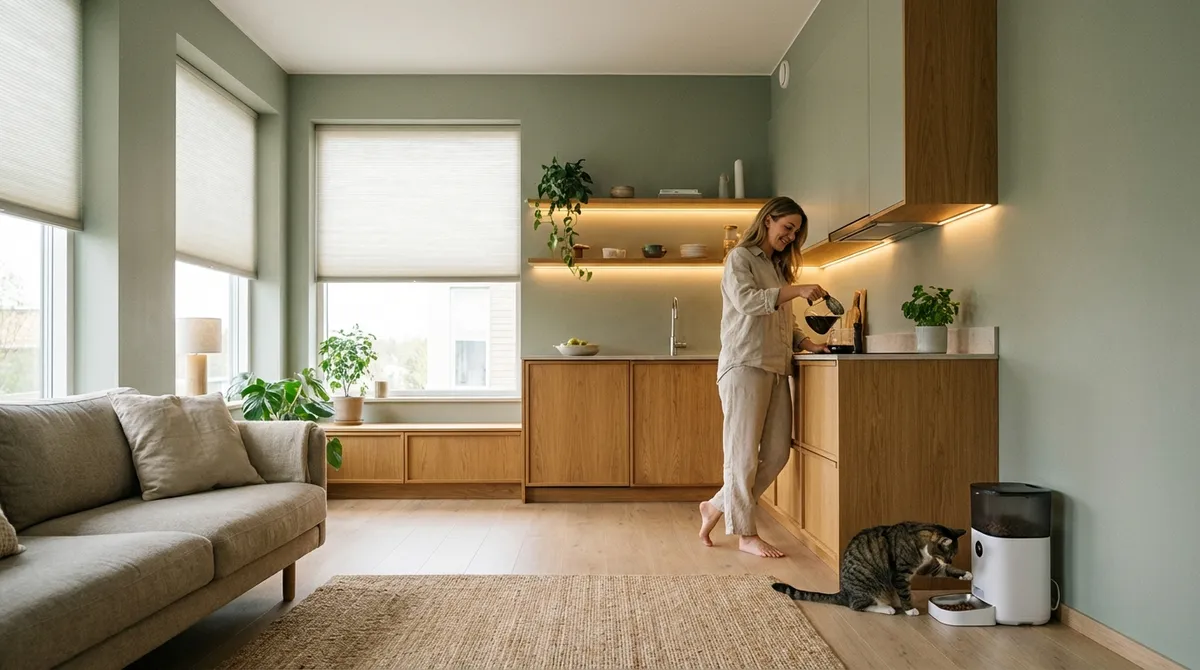
Picture this: a voice assistant tucked inside a cabinet or on a small shelf, controlling under-cabinet lighting, timers, and playlists. A smart plug on your electric kettle or coffee maker lets you start your morning brew from bed. An induction cooktop with built-in safety features (auto-shutoff, pan detection) quietly lowers your stress level if you’re multitasking kids, emails, and pasta water.
Add a few thoughtful layers: a smart scale that links to recipe apps, a fridge camera that lets you check what’s inside from your phone while you’re at the store, or leak sensors under the sink to catch drips before they become disasters. The point isn’t to create a “connected showroom”—it’s to take decision fatigue and tiny annoyances out of everyday cooking, so the kitchen feels more like a creative zone and less like a chore hub.
5. Reset-Ready Spaces: Automation for Transitions, Not Just Tasks
The most underrated luxury in modern living is a home that can reset itself—or at least meet you halfway. Instead of thinking of smart tech as a remote control for single actions, think in terms of transitions: morning → day, day → night, work → rest, home → away.
Automation routines can quietly anchor these pivots. A “Leaving Home” routine might turn off all lights, adjust the thermostat, lock the doors, and pause your robot vacuum until you’re gone. A “Night In” routine could lower blinds, adjust lighting, start a low-volume playlist, and switch your HVAC to a slightly cooler sleep setting later in the evening.
For shared homes, this is also how you create house agreements without having to nag. Motion sensors can bring up dim night lights in hallways and bathrooms so no one wakes up the whole household. Smart plugs can cut power to gaming consoles or high-draw devices during set hours without you having to say a word. The goal isn’t to automate everything—it’s to automate the stuff that drains your mental bandwidth so you have more energy for people, projects, and rest.
Conclusion
A truly modern smart home doesn’t scream for attention; it quietly earns its place in your routines. When your entry is frictionless, your lighting follows your mood, your climate adjusts to how you live, your kitchen helps instead of distracts, and your home can reset itself between the chapters of your day, you get a space that feels both incredibly current and deeply human.
You don’t have to do it all at once. Start with one idea that solves a real annoyance in your life, then build from there. The smartest homes aren’t the most high‑tech—they’re the ones that make your everyday life feel lighter, calmer, and more you.
Sources
- U.S. Department of Energy – Home Energy Management - Overview of smart thermostats, zoning, and energy-saving strategies
- EPA ENERGY STAR – Smart Thermostats - Data on efficiency, comfort benefits, and certified smart thermostat products
- Harvard Medical School – Blue Light Has a Dark Side - Explains how light affects circadian rhythms and sleep, relevant to smart lighting choices
- Consumer Reports – Smart Home Guide - Practical guidance on selecting and integrating smart home devices
- National Fire Protection Association – Cooking Safety - Background on kitchen risks and why smart safety features (like auto‑shutoff) matter
Key Takeaway
The most important thing to remember from this article is that this information can change how you think about Smart Homes.