There’s a new kind of “done” when it comes to interiors—and it’s not about showroom perfection or copying a Pinterest board pixel-for-pixel. Modern homeowners want spaces that feel lived-in but elevated, tech-aware but not tech-obsessed, curated but still easy. Think: a home that holds your routines, your people, and your downtime without feeling like a set.
Below are five innovative home living ideas that lean into that vibe: soft modern, low effort, high impact, and built for real life.
1. The Layered Lighting Grid (Not Just a Pretty Pendant)
Overhead lighting alone is basically the fluorescent office of home design—technically functional, emotionally flat. Updating your “light story” is one of the fastest ways to make a room feel thoughtfully designed, especially in open-plan spaces.
Start by thinking in layers: ambient (overall glow), task (focused light where you actually do things), and accent (moments of drama or softness). A living room might get a slim ceiling fixture on a dimmer, a floor lamp angled toward the sofa for reading, plus a low table lamp that makes nighttime feel cocooned instead of washed out. The trick is avoiding visual clutter: repeat a few finishes (like brushed brass and matte black) so each fixture feels like part of a micro-collection, not a random mashup.
If you can, plan lighting around behavior, not furniture alone. Where do you drop your bag? That’s a perfect place for a wall sconce or small lamp instead of a catchall bowl in the dark. Where do you actually answer emails or scroll at night? A warm, adjustable lamp with a low color temperature (2700–3000K) will feel calmer than a harsh white bulb.
Bonus modern move: integrate a couple of smart bulbs or dimmers—but keep manual switches. The goal is flexibility and mood on demand, not a home you can only operate through an app.
2. Hybrid Zones: Rooms That Shift With Your Day
The most innovative “new” room isn’t really new at all—it’s just less single-purpose. A dining area that turns into a quiet workspace, a bedroom corner that doubles as a micro-yoga zone, or a hallway that functions as a gallery + storage wall are all ways to get more life out of the square footage you already have.
Instead of forcing everything into one generic “multi-purpose room,” think in zones with clear visual and functional boundaries. You might use:
- A slim console table behind the sofa that becomes a laptop perch
- A fold-down wall desk in a guest room so it doubles as a study
- A narrow bench with hidden storage in the entry that also acts as a shoe station and drop spot
- A leaning ladder shelf that holds both books and small trainers, turning a blank wall into a workout-friendly corner
The key is choosing pieces that look intentional in both roles. A sculptural dining chair that works at a desk, or a storage ottoman that’s just as stylish as a side table, lets the room shift without announcing, “Surprise, this is my second job!”
To keep hybrid zones from feeling chaotic, repeat one or two materials across the room—like pale wood and linen, or chrome and boucle—so everything reads as one story, even if each area has its own function.
3. Material Stories: Mixing Textures Like a Stylist, Not a Showroom
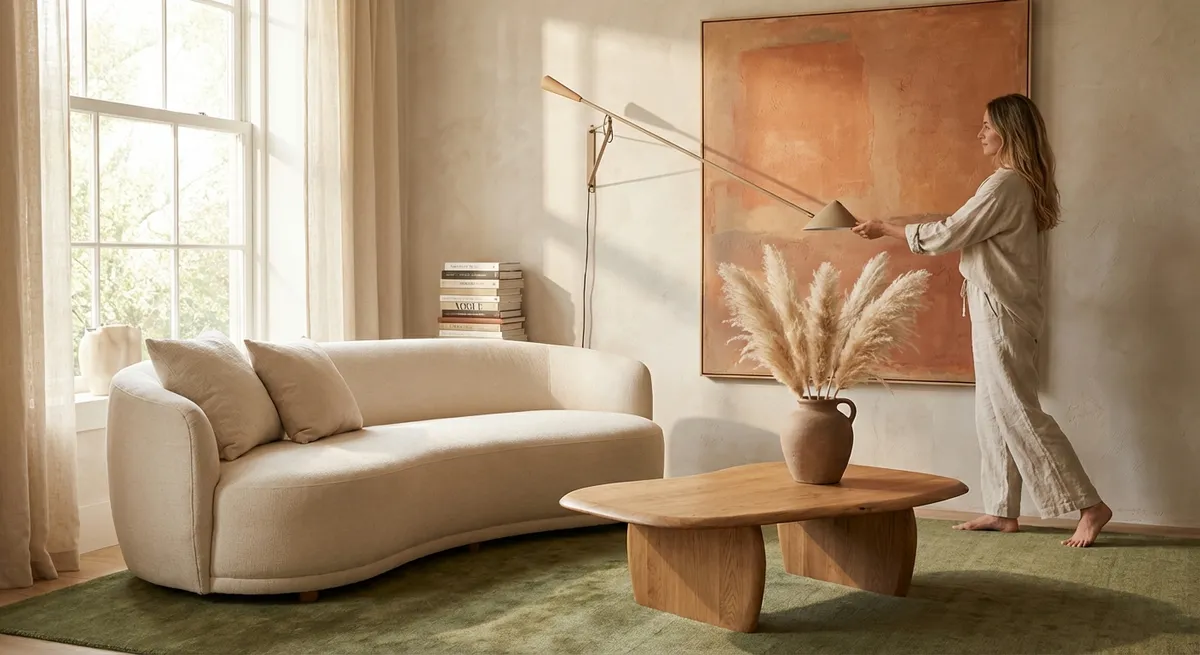
Modern interiors are less about matching sets and more about a curated mix that feels collected, not chaotic. An easy way to get there: build “material stories” in each room—a tight palette of textures and finishes that contrast in all the right ways.
Start with one anchor texture that feels calm (think: oak, plaster, wool, or rattan), then layer in 2–3 “supporting characters.” In a living area, that might look like:
- A low-profile linen sofa as the quiet base
- A dark wood coffee table with visible grain for warmth
- A ribbed glass lamp that catches the light
- A chunky wool rug to ground everything
The magic is in contrast: shiny vs. matte, smooth vs. nubby, light vs. dark. This keeps neutrals from feeling flat and lets bolder colors land more softly. Instead of chasing trends room by room, repeat threads of the same materials throughout the home—a black metal detail on kitchen stools that reappears on bedroom nightstands, or a stone tone from the bathroom echoed in living room ceramics.
If you’re renting or not ready to renovate, focus your material story on items you can take with you: lighting, textiles, occasional furniture, art, and objects. They’ll make even a plain white box feel layered and specific.
4. Calm-First Bedrooms: Designed Around Sleep, Not Screens
The most innovative bedroom design move right now isn’t a statement headboard—it’s rearranging the space around sleep quality and mental reset. We’re finally thinking of the bedroom as a recovery studio, not a mini living room.
Start with placement: if possible, position your bed so you can see the door without being directly in line with it, and catch natural light without having sunrise in your eyes at 6 a.m. Then edit the visual noise ruthlessly. Keep surfaces as clear as possible, and choose closed storage over open shelving in sleeping zones so your brain isn’t processing clutter before bed.
Think of the bed as a layered system, not just a mattress plus “some sheets.” A supportive mattress, breathable natural fiber sheets (like cotton percale or linen), and one or two weightier layers (a quilt, blanket, or duvet) let you adapt to different seasons and sleep preferences. If you share the bed, consider separate throws in coordinating colors—visually cohesive, thermally independent.
Lighting in bedrooms should be soft and directional. A pair of wall-mounted reading lights frees up nightstand space and feels quietly hotel-level. Add one warm-glow lamp on a dimmer or smart bulb setting for pre-sleep reading and journaling, and if you keep a TV or screens in the room, counterbalance the blue light with amber or warm white lamps instead of bright overhead fixtures.
Micro-luxury upgrade: designate one surface as your “reset station”—a tray with water, a small carafe, hand cream, and a book or notepad. It’s a tiny still life that nudges you toward unwinding, not doomscrolling.
5. Emotional Decor: Displaying Your Life, Not Just “Objects”
The most compelling homes right now aren’t the most expensive—they’re the ones that feel like someone actually lives there. Emotional decor is about choosing what’s visible with intention: not just “a vase here, a print there,” but objects and art that tell your story in a low-key, modern way.
Think of your walls and shelves as edit points, not storage. Start by pulling everything down, then reintroduce only what feels like it reflects who you are now: travel photos printed in a consistent format, a piece of art from a local maker, a framed playbill or postcard, a ceramic bowl from a friend. Group these into tight moments—gallery walls, styled shelves, or a single strong piece—rather than scattering small items everywhere.
To keep things feeling elevated, pair emotional pieces with simpler, sculptural forms: a plain linen-covered book stack under a sentimental object, a clean-lined frame for an old photograph, or a minimalist bench under a gallery wall of family images. The contrast keeps things from veering into clutter or nostalgia overload.
Rotate what you display seasonally, the way you’d rotate your wardrobe. A quick swap of art, textiles, and objects can shift a room from high summer (light textures, beach photos, glass) to cozy season (wool throws, candle holders, darker ceramics) without repainting or buying all new furniture. Your home stays visually interesting and more aligned with how you’re actually living right now.
Conclusion
Modern interior design isn’t about chasing the next viral sofa or turning your home into a tech demo. It’s about small, future-focused choices that make everyday living smoother, calmer, and more you—layered lighting that flexes with your mood, rooms that shift roles as easily as you do, texture mixes that feel intentional, bedrooms that actually help you rest, and decor that reflects your actual life instead of a catalog spread.
If you treat each room like a living system—something you can keep editing as your routines and tastes evolve—you’ll end up with a home that feels quietly current for a long time, not just “on trend” for a season.
Sources
- American Lighting Association – Residential Lighting Tips – Practical guidance on layering ambient, task, and accent lighting
- Harvard Medical School – Blue Light Has a Dark Side – Research-based explanation of how light impacts sleep and why warm, low-intensity lighting at night matters
- Sleep Foundation – Bedroom Design for Better Sleep – Evidence-backed recommendations on arranging the bedroom to support sleep quality
- American Society of Interior Designers (ASID) – 2024 Trends Report – Insights into current interior design directions, including multi-functional spaces and wellness-focused design
- New York Times – Making the Most of a Small Space – Real-world strategies for multi-purpose rooms, zoning, and storage in modern homes
Key Takeaway
The most important thing to remember from this article is that this information can change how you think about Interior Design.