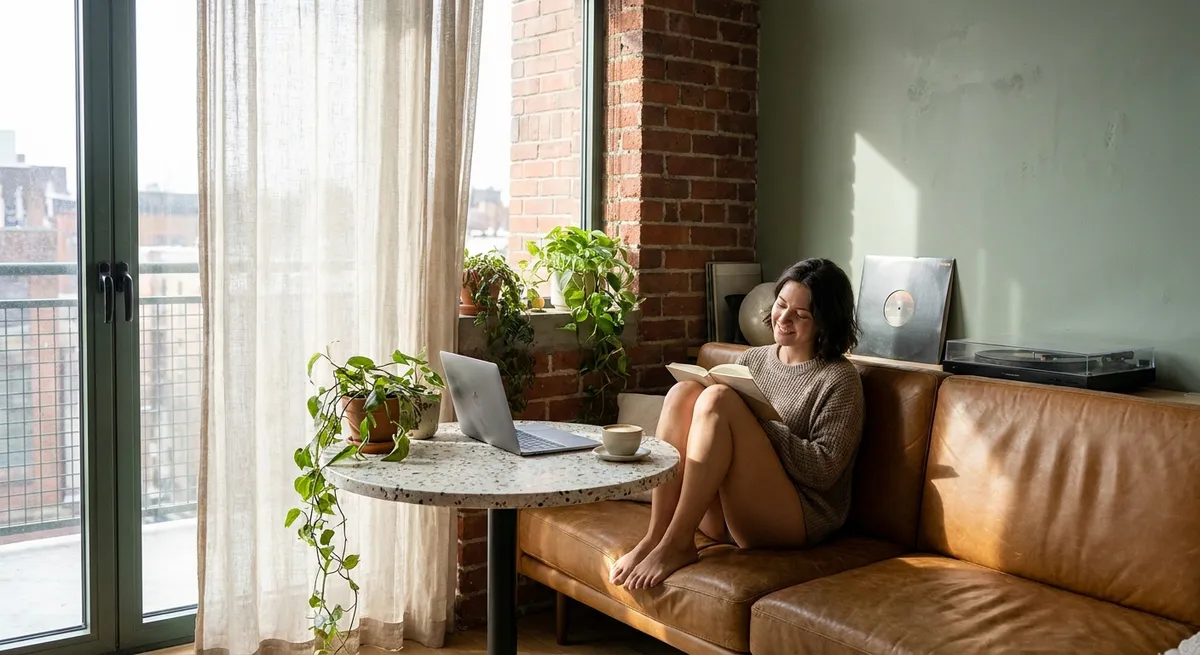
There’s a new interior mood quietly taking over: homes that feel less like showrooms and more like your favorite corner table in a great city café—easy, layered, a little bit undone, but very intentional. It’s not about big renovations or chasing trends; it’s about micro-upgrades that make your space feel lived-in, social, and smart without trying too hard. Think soft lighting, tactile finishes, and tech that hides in plain sight. Below are five innovative home living ideas that bring that “soft-urban” energy into any space, whether you’re in a studio or a full house.
1. Gallery-Lounge Walls: Art You Can Rearrange on a Whim
Instead of committing to one big statement piece, build a flexible “gallery-lounge” wall that can evolve with you. Use slim picture ledges, mixed frames, and objects that tell your story—vinyl covers, travel photos, typography prints, or even pressed florals. The idea is to treat your wall like a real-time mood board rather than a final, finished project.
Layer frames by overlapping sizes, mix black, oak, and brass finishes, and combine art prints with tactile pieces like woven wall hangings or small sculptural shelves. To keep it feeling elevated (not chaotic), stick to a loose color story—maybe warm neutrals with one accent shade or black-and-white photography with a single pop color that shows up in every row.
What makes this innovative for modern living is the ease of change. New city? New phase of life? Shift your wall in an hour by swapping prints or adding a new object. Paired with a low-profile sofa and a slim floor lamp nearby, your “gallery-lounge” becomes a backdrop for both solo nights in and casual hangs with friends.
2. Hybrid Work Nooks: Desks That Disappear After 6 PM
The home office isn’t going anywhere, but the static “office corner” vibe definitely is. Modern homeowners are moving toward hybrid work nooks—spaces that fully function as a workstation by day, then visually vanish after hours so the home doesn’t feel like a permanent office.
Look for slim, wall-mounted desks, secretary-style consoles, or fold-down tables that can close to hide your laptop and cables. Pair them with a dining-chair-style seat instead of a bulky rolling chair, so it can double at the table when you’re entertaining. Keep only one small tech hub visible—a sleek charging station or a minimal monitor on an arm—then hide everything else in drawers, boxes, or a nearby credenza.
Styling cues matter here: a table lamp instead of a corporate desk lamp, framed art above the screen, and a plant that softens the corner instantly. Anchor the zone with a rug that defines your “work bubble” but still belongs in your living aesthetic. The goal is psychological as much as visual: when the work surface is closed or cleared at night, your brain gets a built-in cue that the day is done.
3. Texture-First Spaces: Building Rooms Around How They Feel, Not How They Look
Instead of starting with a color palette or furniture style, start with a texture palette: what do you want the room to feel like under your hands and feet? Soft-urban interiors are defined less by matching sets and more by contrasts—linen against metal, boucle against wood, glass layered with rough ceramics.
Layer a low pile rug with a smaller, super-soft rug on top where your feet land. Mix smooth finishes (lacquer, glass, polished stone) with high-texture elements (slub woven cushions, chunky knit throws, ribbed pottery). In the bedroom, think crisp cotton sheets with a washed-linen duvet and one oversized, nubby throw that feels almost like a wearable blanket.
This texture-first mindset is an upgrade from the usual “neutral equals boring” trap. You can keep your color palette calm—beige, sand, olive, charcoal—but still have a space that feels rich and tactile. Modern homeowners, especially in smaller urban spaces, appreciate that they can transform the entire mood with texture without needing to repaint or buy bulky furniture.
4. Scent Zoning: Using Fragrance as Invisible Interior Design
We’re used to zoning our homes by furniture and rugs; a more innovative layer is zoning by scent. Different areas, different fragrance “stories.” It’s a quiet way to create micro-worlds in a compact space and anchor rituals without adding visual clutter.
In the entryway, pick a clean, citrus or herbal scent that feels like a reset the moment you walk in. In the living room, go for warm woods, soft florals, or subtle amber blends that feel social and cozy. For work nooks, lean into fresher, more energizing profiles like eucalyptus or mint. For the bedroom, choose calming notes—lavender, chamomile, or soft musk.
Use a mix of methods so it doesn’t feel overwhelming: a plug-in diffuser on a low setting in one zone, a candle you only burn during evening wind-down, a room spray that comes out right before guests arrive, or a reed diffuser tucked on a bookshelf. The key is consistency: over time, your brain starts to associate certain scents with certain habits—deep focus, slow mornings, or actual rest.
5. Social Islands: Micro-Hosting Spots in Unexpected Places
Not everyone has a full dining room or a bar cart moment, but that doesn’t mean your home can’t be quietly built for hosting. “Social islands” are small, intentional setups that make it easy to say “come over” without a full reset—little pockets of readiness woven into your layout.
In the kitchen, this might be a slim console or rolling cart against a wall with stacked glasses, a carafe, cloth napkins, and a bowl that’s always ready for chips, olives, or cut fruit. In the living room, it could be a side table that’s always cleared enough for drinks, with a tray underneath holding coasters, a deck of cards, and a candle. Even a hallway can host a mini bench with a basket of extra slippers or throws for guests.
Lighting turns these islands into a vibe: a dimmable sconce over a cart, a narrow table lamp on a console, or a portable, rechargeable lamp that moves where the people are. The innovation here isn’t the furniture—it’s the mindset. Instead of waiting to “host properly” someday, you embed micro-rituals into your layout now, so your home is always five minutes away from feeling ready.
Conclusion
Modern interiors aren’t about perfection; they’re about intentional ease. A gallery-lounge wall you can change on a whim, a work nook that disappears after 6, texture-driven comfort, scent-zoned rituals, and quiet social islands all add up to a home that actually fits the way you live now. The upgrades are small, but the lifestyle shift is real: less performance, more personality. Design it like your favorite café—somewhere people want to stay a little longer—and suddenly, staying in feels like going out.
Sources
- Harvard Graduate School of Design – The Home as a Workplace - Discussion and research around how living spaces are adapting to remote work
- American Society of Interior Designers (ASID) 2023 Trends Outlook - Insights into evolving interior design trends and homeowner preferences
- Sleep Foundation – How Smell Affects Sleep - Explains how scent can influence relaxation and nighttime routines
- Environmental Protection Agency (EPA) – Introduction to Indoor Air Quality - Context on indoor environments, helpful when considering scented products at home
- New York Times – The Power of Texture in Interior Design - Explores how textures transform the feel and visual interest of a room
Key Takeaway
The most important thing to remember from this article is that this information can change how you think about Interior Design.