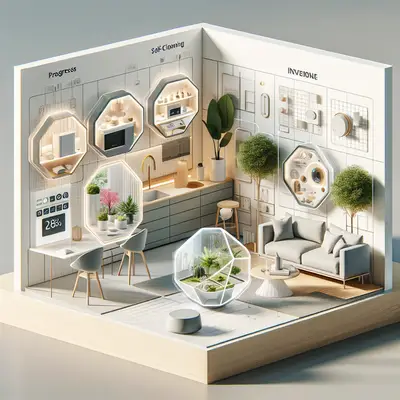
Minimalism had its moment. Now, it’s about something smarter: keeping the things that actually make your life better, and designing your home around how you live—not how you wish you lived. The edited-down home isn’t about owning less just to be “aesthetic”; it’s about making every piece work harder, feel better, and look good from every angle (yes, including the one your phone camera loves most).
These five ideas lean into modern living: compact, tech-aware, wellness-forward, and quietly elevated. Think: less clutter, more clarity—without your place feeling like a showroom.
1. The “Daily Drop Zone” That Actually Works
Every home has a chaos zone: keys, bags, chargers, random mail. Instead of fighting it, design for it.
Start by picking the exact spot where you naturally drop things—near the entry, by the kitchen, or beside your desk. Then upgrade it from clutter corner to intentional landing strip. A slim console, wall-mounted shelf, or floating drawer keeps the footprint light. Add a small tray for keys and headphones, a vertical file or magazine rack for mail, and one catch-all basket with a clear rule: if it doesn’t fit, it doesn’t stay.
To keep it visually calm, stick to one or two materials—maybe light wood and matte black, or stone and soft chrome—so the area feels curated, not busy. A low-profile wireless charging pad and a small table lamp or sconce turn it into a functional mini-hub you’ll actually use daily, not just admire on move-in week.
2. Furniture That Shifts With Your Day
Modern homes aren’t just “open plan”—they’re “open purpose.” Your living room might be your office, workout zone, movie theater, and hosting space all in 24 hours. The trick is choosing furniture that doesn’t lock you into one layout.
Think modular sofas you can reconfigure without a full workout, nesting coffee tables that split into side tables for extra guests, and ottomans with hidden storage that double as seating. Lightweight accent chairs on gliders or slim-profile casters make it easy to pivot your layout from “laptop mode” to “friends are over” in minutes.
Visually, keep the palette consistent across functions so the space feels calm even when its job description changes. Neutrals with one or two accent tones age better than trend-heavy colors, and performance fabrics in textured weaves (bouclé, linen blends, subtle herringbone) keep things practical without losing that boutique-hotel vibe.
3. Soft Boundaries: Zoning Without Walls
You don’t need walls to create rooms. You just need boundaries that are soft, movable, and good-looking.
Use large area rugs to visually “anchor” zones—one under the sofa and media unit for lounging, another under a dining table or work table. Mix in vertical elements: a tall plant cluster, an open bookshelf, or a slatted room divider that lets light through while breaking up the sightline. Even lighting can zone a space: a floor lamp over the reading corner, a pendant over the table, a table lamp by the sofa.
Fabric is your quiet secret weapon. Sheer curtains can separate a sleep area in a studio without making it feel boxed in. A ceiling-mounted curtain track lets you slide privacy in and out as needed—perfect for home offices that disappear after 6 PM. The goal isn’t to hide your life; it’s to visually organize it so your eye (and brain) can relax.
4. Texture-First Styling for Instant Warmth
If your space feels flat on camera or in real life, it’s usually not a color problem—it’s a texture problem. Texture is what makes a room feel lived-in instead of staged.
Layer different tactile elements in the same color family: a chunky knit throw on a smooth cotton sofa, a boucle pillow on a leather chair, a natural jute rug under a sleek coffee table. Stick to 2–3 main materials repeated in different ways—like pale wood, black metal, and linen—to create a through-line that feels intentional.
Don’t forget vertical texture. Limewash paint, grasscloth wallpaper, ribbed or fluted wood panels, and even a simple gallery wall with varied frames add dimension without visual noise. In smaller homes, aim for “quiet texture”: pieces that feel rich up close but don’t shout from across the room. This is how you get that elevated, editorial look without needing a giant budget or a full renovation.
5. Micro-Retreats: Built-In Calm in Small Corners
You don’t need a whole room to feel like you have space for yourself—you just need one thoughtfully designed corner that signals “off-duty.”
Pick a small area with decent light (natural is ideal, but a good lamp works) and give it a single, clear purpose: reading, journaling, stretching, or just scrolling in peace. Add a comfortable chair or floor cushion, a side table for a drink or book, and warm, directed lighting. Keep the color palette softer here than the rest of the room—think muted neutrals, soft greens, or warm beiges—to visually cue calm.
Elevate it with small rituals: a tray for a candle and lighter, a closed basket for blankets or yoga gear, a stack of books you actually want to reach for. The key is friction-free access—if you have to dig through clutter to reach this spot, you won’t use it. When designed well, this micro-retreat becomes the place you instinctively go to decompress, even if the rest of life feels loud.
Conclusion
Modern interior design isn’t about chasing trends or perfectly staged rooms—it’s about building spaces that quietly support the way you actually live. A working drop zone, shapeshifting furniture, soft zoning, texture-rich styling, and a micro-retreat give your home range: ready for friends, ready for focus, and ready for rest.
The edited-down home doesn’t ask you to live less. It just asks every piece to do a little more, so you can think a little less about your space—and enjoy living in it a lot more.
Sources
- American Society of Interior Designers (ASID) – 2024 Trends Outlook - Industry report on how people are using homes for multiple functions and what design elements support modern living
- Harvard Joint Center for Housing Studies – The Future of Home - Research on evolving residential spaces, including flexibility and multifunctional design
- NYTimes: How to Make a Small Space Feel Bigger - Practical design tips on zoning, furniture choice, and layout for compact homes
- Architectural Digest – A Designer’s Guide to Layering Textures - Explores how texture adds warmth, depth, and visual interest to interiors
- Mayo Clinic – Stress Management and the Power of Quiet Spaces - Explains how dedicated calm spaces and rituals can support mental well-being in daily life
Key Takeaway
The most important thing to remember from this article is that this information can change how you think about Interior Design.